
the viral choke point
RdRp Thumb-1
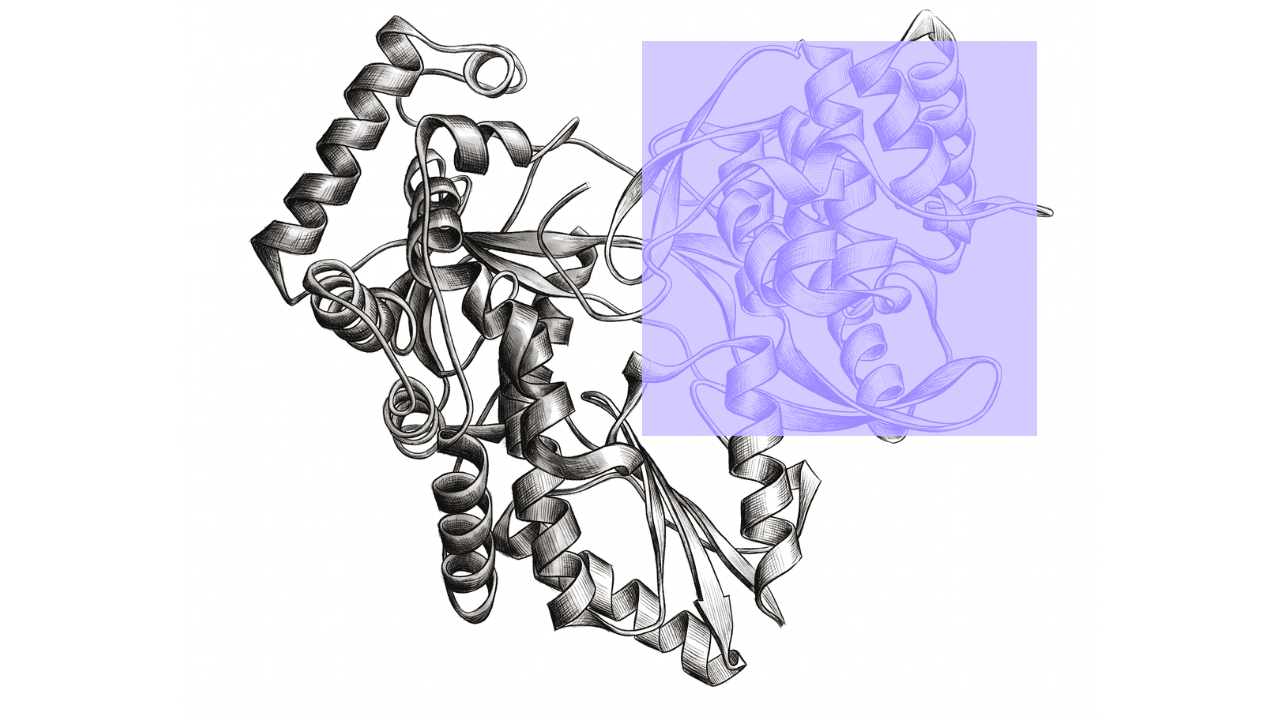
A cryptic allosteric pocket on viral RNA polymerase, conserved across six viral families. For decades, the field could not design a direct-acting antiviral without relying on nucleosides or protease inhibitors, severely limiting broad-spectrum potential. Model Medicines aims to solve this.
Overview of RdRp Thumb-1
RdRp Thumb-1 is an allosteric pocket on the viral RNA-dependent RNA polymerase (RdRp). every single-stranded RNA virus uses this enzyme to copy its genome. The site sits at the interface between a finger-domain loop (the Λ1-loop) and the upper thumb domain of the polymerase. When occupied by a small molecule, the polymerase cannot transition into its catalytically competent initiation state. RNA synthesis halts.
The pocket is cryptic. It opens only when a competing ligand displaces the loop. That structural feature is what makes the site biologically essential. It is also why the site eluded the field.
Model Medicines has discovered that the Thumb-1 pocket and its Λ1-loop interaction are conserved across at least six single-stranded RNA virus families, including: Orthomyxoviridae, Pneumoviridae, Coronaviridae, Flaviviridae, Kolmioviridae, and Hepadnaviridae. One pocket. Many viruses. One mechanism.
The clinical opportunity:
Chronic Hepatitis
HCV, HBV, HDV; 312 million people infected globally; 1.3 million deaths annually from cirrhosis and hepatocellular carcinoma.
The annual respiratory tripledemic
Influenza, RSV, SARS-CoV-2; hundreds of millions of infections, hundreds of thousands of deaths each year, no approved single-agent therapy.
Pandemic readiness
Every novel single-stranded RNA virus that emerges into the human population.
A single Thumb-1 inhibitor addresses all three.
Mechanism of Action
Viral RdRp must transition from an apo conformation to an initiation-competent conformation before RNA synthesis can begin. The Λ1-loop is the structural lever. In the apoprotein, its α-helix occupies the Thumb-1 pocket and bridges the finger and thumb domains. During polymerase initiation, the loop swings out, allowing the polymerase to enclose the nascent RNA strand.
Thumb-1 inhibitors hijack this mechanism. They compete with the Λ1-loop for the Thumb-1 pocket. When the inhibitor wins the competition, the loop cannot complete its conformational change, the polymerase cannot enclose the template, and viral RNA synthesis is blocked at initiation.
The pocket's conservation across viral families is a consequence of conservation in the initiation mechanism itself. Every single-stranded RNA virus that depends on RdRp depends on this conformational transition.
This is the structural reason a single inhibitor can be genuinely broad-spectrum, and the reason Thumb-1 is a choke point in the strict sense of the word.
Historical Difficulties
For decades, the field held that broad-spectrum non-nucleoside antivirals were biologically impossible. The conclusion rested on two arguments, one theoretical, one empirical. Theoretically, allosteric pockets on viral polymerases were assumed to be too poorly conserved to support a single chemical scaffold across families. Empirically, beclabuvir, the only approved Thumb-1 inhibitor, registered in Japan in 2016, is inactive against poliovirus, rhinovirus, coronavirus, coxsackievirus, influenza, and HIV. Twenty years of HCV-focused Thumb-1 chemistry had produced one approved drug, with one indication.
The Thumb-1 site has been visible in the HCV literature for two decades. Pharma BD teams, academic structural biologists, and computational drug-discovery groups have all had access to the same crystal structures Model Medicines worked from. The site was missed because conventional drug discovery has two failure modes against cryptic targets.
Brute-force screens cannot find chemistry the library does not contain.
Physics-based docking cannot model a pocket that does not exist.
The target had been visible. The methods used to interrogate it had not.
Overcoming the Difficulty with AI
Model Medicines applied AI at both stages: target discovery and drug discovery.
Target discovery. GALILEO™ combined homology modeling with multiple sequence alignment across 35 single-stranded RNA viruses spanning eight viral families. The work identified the inhibitor-proximal residues and demonstrated that those residues are conserved across all sampled +ssRNA families. The Λ1-loop's structural interaction with the pocket is similarly preserved. Model Medicines discovered the pocket is not a HCV-specific accident. It is a family-level target.
Drug discovery. Using a molecular-geometric deep learning model, GALILEO™ learns directly from in vitro bioactivity data without requiring a protein structure. For a cryptic site that conventional docking cannot model, this is decisive.
The training data was built in three layers. Level 1 captured explicit HCV Thumb-1 inhibitor data. Levels 2 and 3 captured proprietary, implicit non-HCV inhibitor data. This included compounds from RdRp-specific and whole-virus assays that match a pharmacophoric model the team constructed around the three core Thumb-1 scaffolds. The combined dataset informed GALILEO™ what cross-family Thumb-1 chemistry looks like. All without ever requiring an open-pocket structure.
Every in vitro and in vivo result that followed validated the prediction.
Lead Asset
MDL-001 is a direct-acting, non-nucleoside, broad-spectrum antiviral targeting a conserved viral polymerase mechanism, with demonstrated preclinical activity across respiratory and hepatic viruses and high-risk co-infections. MDL-001 is being developed across major respiratory infections, including influenza, COVID-19, and RSV, as well as chronic hepatitis infections, including HCV, HBV, and HDV, representing an estimated combined global antiviral market exceeding $30 billion annually. By targeting a conserved polymerase mechanism shared across viral families, the program is designed to provide a unified, oral therapeutic approach spanning both seasonal respiratory outbreaks and chronic liver disease, including high-risk co-infected patient populations. The program is currently completing IND-enabling studies. IND submission is targeted for 2027 with clinical trials estimated to commence in 2027.